
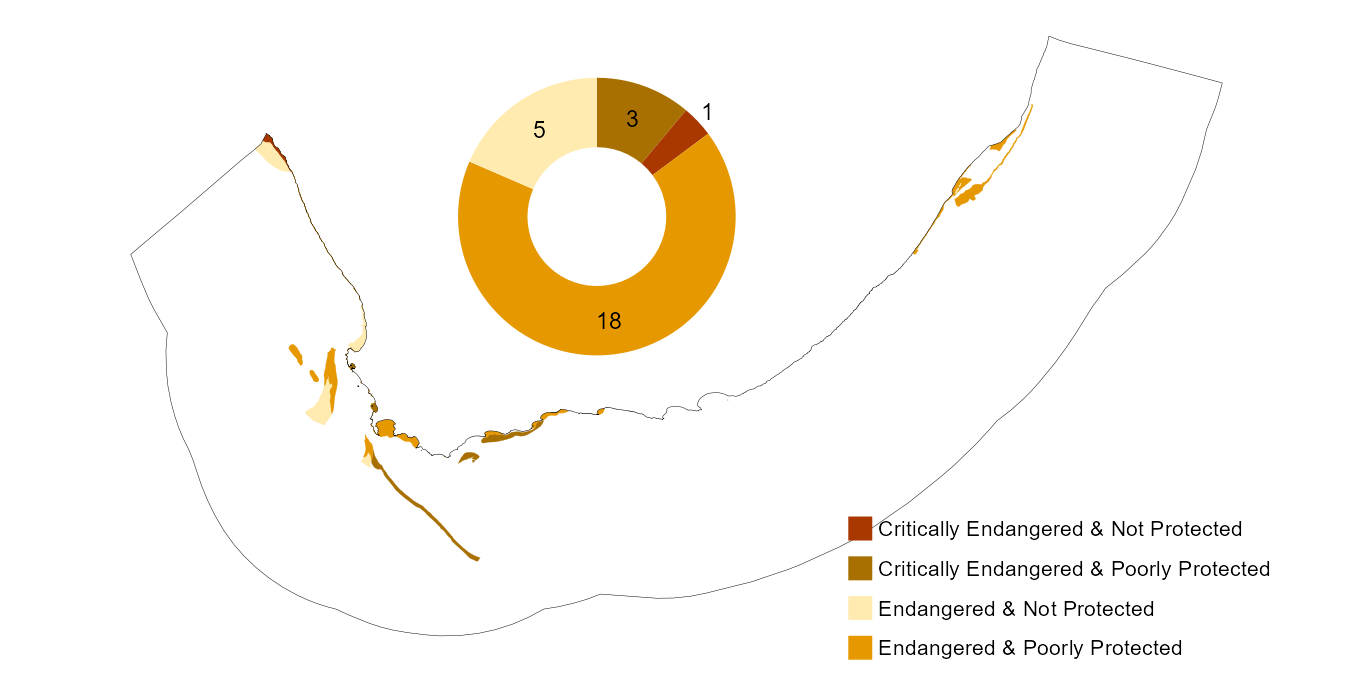
Of South Africa’s 163 marine ecosystem types, 27 (17%) are both highly threatened and under-protected. Threatened and under-protected ecosystem types are candidates for improved protection through MPA expansion or other spatial management measures that could be recognised as Other Effective Conservation Measures (OECMs). In addition to expansion of protection of these ecosystem types, it is important to improve ecosystem condition through flow restoration, alleviation of pressures and improved ecosystem management.
Intersection of ecosystem threat status and protection level results
The headline indicators of the NBA provide information on the pressures faced by species and ecosystems and on the progress made in protecting them. Combining the indicators provides an additional perspective on the status of marine ecosystems. There are 27 marine ecosystem types that are both highly threatened and under-protected (Figure 1; Table 1).
| Threat status | Not Protected | Poorly Protected |
|---|---|---|
| Critically Endangered | Orange Cone Inner Shelf Mud Reef Mosaic | |
| Critically Endangered | Agulhas Muddy Mid Shelf | |
| Critically Endangered | Browns Bank Rocky Shelf Edge | |
| Critically Endangered | Cape Bay | |
| Endangered | Cape Lower Canyon | |
| Endangered | Cape Sheltered Rocky Shore | |
| Endangered | KZN Bight Mid Shelf Reef Complex | |
| Endangered | Orange Cone Muddy Mid Shelf | |
| Endangered | St Helena Bay | |
| Endangered | Durnford Inner Shelf Reef Complex | |
| Endangered | Trafalgar Reef Complex | |
| Endangered | Agulhas Sheltered Rocky Shore | |
| Endangered | Namaqua Exposed Rocky Shore | |
| Endangered | Namaqua Sheltered Rocky Shore | |
| Endangered | Namaqua Very Exposed Rocky Shore | |
| Endangered | Agulhas Reflective Sandy Shore | |
| Endangered | Southern Benguela Reflective Sandy Shore | |
| Endangered | KZN Bight Deep Shelf Edge | |
| Endangered | KZN Bight Mid Shelf Mosaic | |
| Endangered | Southern KZN Inner Shelf Mosaic | |
| Endangered | KZN Bight Sandy Inner Shelf | |
| Endangered | Southern Benguela Muddy Shelf Edge | |
| Endangered | Western Agulhas Bay | |
| Endangered | Cape Upper Canyon | |
| Endangered | False and Walker Bay | |
| Endangered | Cape Mixed Shore | |
| Endangered | Namaqua Mixed Shore |
The highest priorities are the Critically Endangered Orange Cone Inner Shelf Mud Reef Mosaic which is Not Protected and the five ecosystem types that are both Endangered and Not Protected (Table 2). This includes the Orange Cone Muddy Mid Shelf, Cape Lower Canyon, St Helena Bay, Cape Sheltered Rocky Shore and the KZN Bight Mid Shelf Reef Complex. Three ecosystem types are Critically Endangered and Poorly Protected; the Agulhas Muddy Mid Shelf, Browns Bank Rocky Shelf Edge and Cape Bay. Endangered and Poorly Protected ecosystem types include several shore types in the Namaqua, Cape and Agulhas Regions, False and Walker Bay, Western Agulhas Bays, two ecosystem types on the southern KwaZulu-Natal (KZN) shelf and four ecosystem types in the KZN Bight.
| Not Protected | Poorly Protected | Moderately Protected | Well Protected | Total | |
|---|---|---|---|---|---|
| Critically Endangered | 1 | 3 | 2 | 0 | 6 |
| Endangered | 5 | 18 | 7 | 1 | 31 |
| Vulnerable | 2 | 12 | 17 | 5 | 36 |
| Near Threatened | 3 | 7 | 6 | 3 | 19 |
| Least Concern | 16 | 16 | 16 | 23 | 71 |
| Total (n) | 27 | 56 | 48 | 32 | 163 |
Threatened and under-protected ecosystem types are candidates for improved protection through MPA expansion or other spatial management measures that could be recognised as OECMs. In addition to expansion of protection, it is important to improve ecosystem condition through strategic alleviation of pressures such as restoration of freshwater flow to the marine environment and improved ecosystem management. Improved bycatch management (priority action 5) and diversified measures to protect bathers from sharks using non-lethal measures (Improvements in shark control measures) could help improve ecosystem condition in KZN.
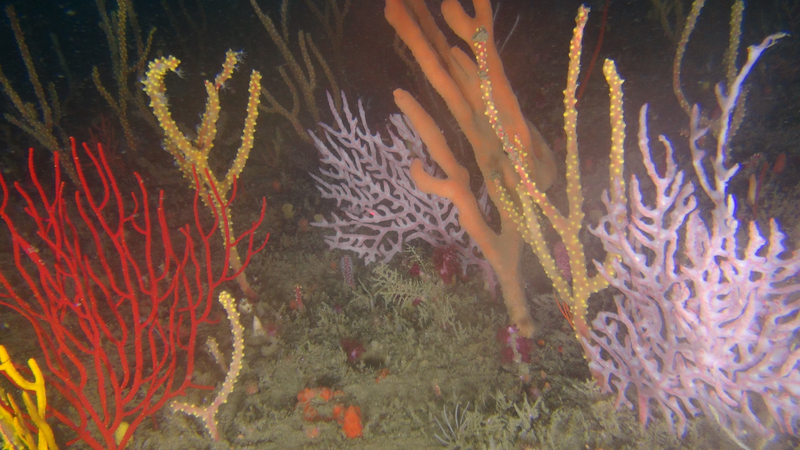
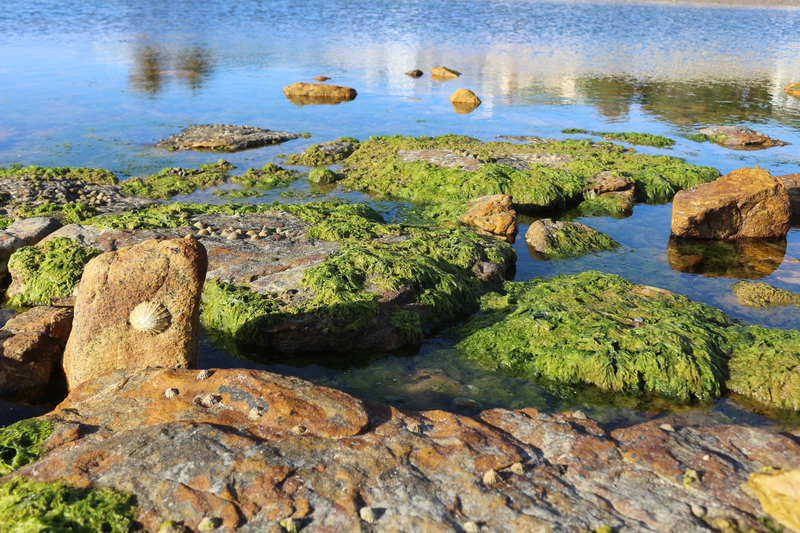
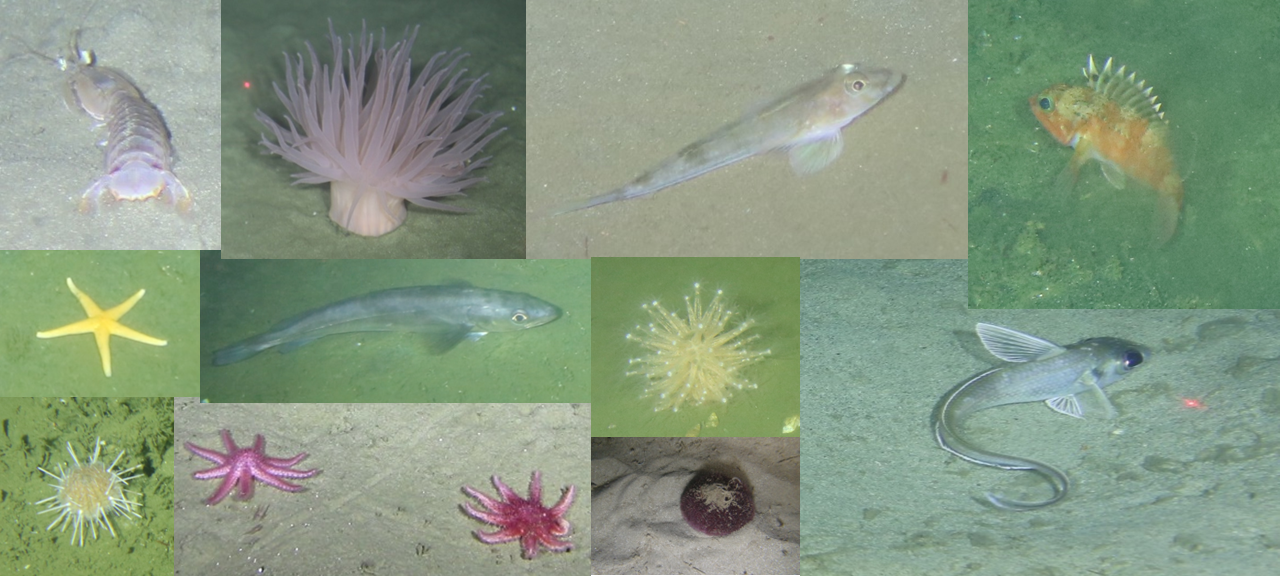
Under-protected, but Least Concern ecosystem types are also candidates for improved protection. Such ecosystems types may not be currently experiencing serious pressure or decline in ecological condition, but are perhaps easier targets for protection through MPAs or OECMs. For example, the Namaqua Muddy Sands, is a distinct ecosystem type that is currently not represented in South Africa’s conservation estate. Improved spatial planning can help find the best area to protect this ecosystem type, by considering other habitat and species priorities. This ecosystem types hosts Vulnerable Marine Ecosystems (VMEs)1.
There is good progress in evaluating the ecological, socio-economic and governance effectiveness of South Africa’s MPAs2–5, which reveal gaps in participation, cultural heritage protection and governance limiting progress in protection. Lessons from the 2019 Marine Protected Area expansion are important for future expansion efforts.
Acknowledgements
We thank all contributors as reflected in the Ecosystem Threat Status and Protection Level pages.
Technical documentation
Code repositories
Recommended citation
Sink, K.J., Besseling, N.A., Adams, L.A., & Currie, J.C. 2026. Intersection of ecosystem threat status and protection levels: Marine realm. National Biodiversity Assessment 2025. South African National Biodiversity Institute. http://nba.sanbi.org.za/.
References
1. Franken, M. 2025. A systematic approach to the identification, mapping and spatial prioritisation of Vulnerable Marine Ecosystems in South Africa.
2. Kirkman, S. et al. 2021. Evaluating the evidence for ecological effectiveness of South Africa’s marine protected areas. African Journal of Marine Science 43: 389–412. https://doi.org/10.2989/1814232X.2021.1962975
3. Mann-Lang, J. et al. 2021. Social and economic effects of marine protected areas in South Africa, with recommendations for future assessments. African Journal of Marine Science 43: 367–387. https://doi.org/10.2989/1814232X.2021.1961166
4. Kirkman, S. et al. 2023. The road towards effective governance and management of marine protected areas in South Africa: Evolving policies, paradigms and processes. African Journal of Marine Science 45: 63–86. https://doi.org/10.2989/1814232X.2023.2203186
5. Sink, K.J. et al. 2023. SeaPeople: Improving participation in ocean protection and conservation efforts. Co-design workshop report for the emerging SeaPeople Collective, 12 December 2023. Cape Town, South Africa.