
The intersection of ecosystem threat status and protection level reveals protected areas expansion priorities and challenges in Fynbos, Grassland and Desert Biomes.
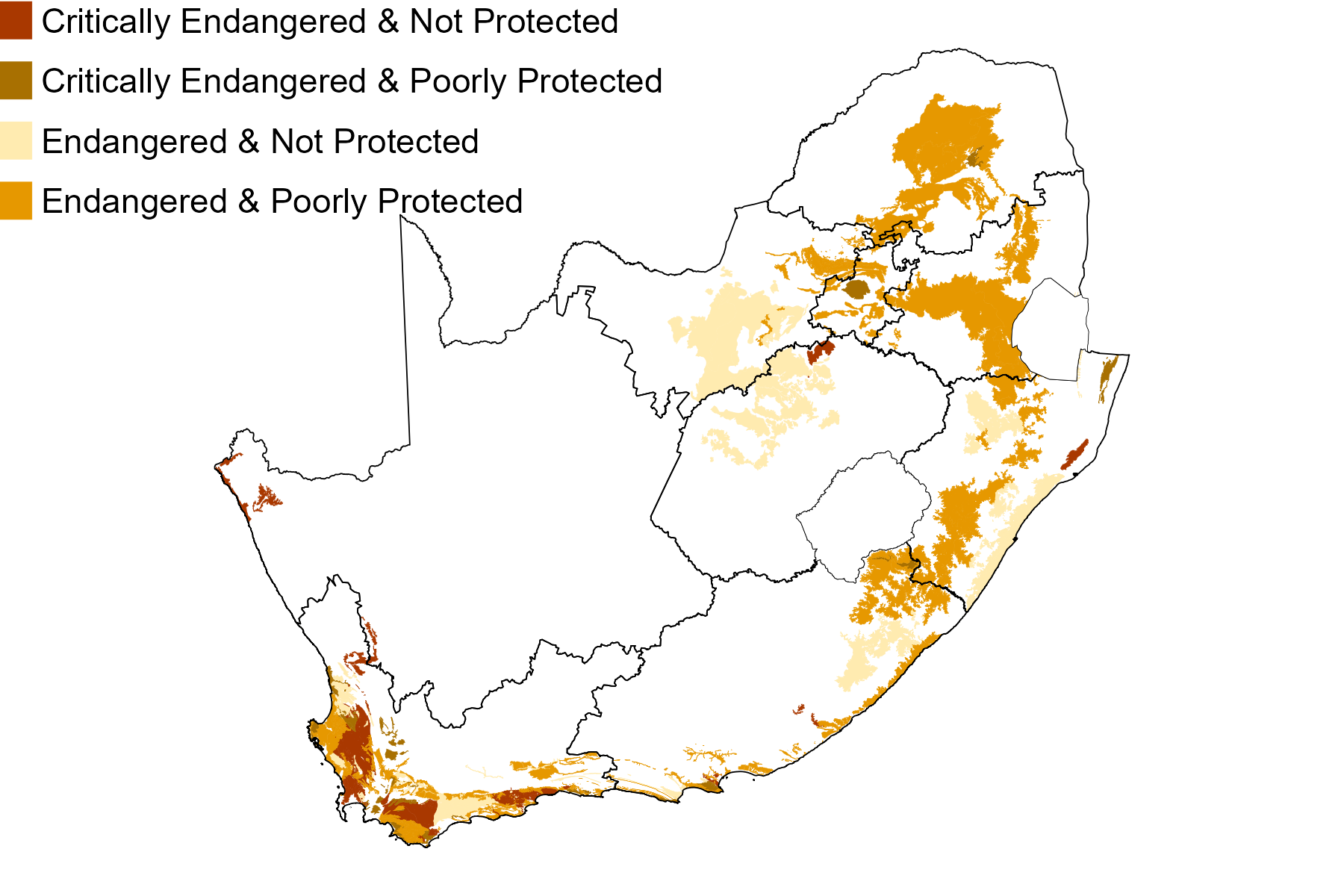
Close to a quarter (105/463) of terrestrial ecosystems are highly threatened and under-protected (Critically Endangered or Endangered and Not Protected or Poorly Protected). Three of the six ecosystem types making up the Indian Ocean Coastal Belt Biome, and 40% of Fynbos ecosystem types (50/126) fall into this category. Within the Fynbos Biome, renosterveld ecosystems are particularly highly threatened and under-protected (17/30 types), highlighting a general trend globally where fragmented lowland regions which have seen extensive habitat loss from cropland development and human settlement are rarely included in protected areas networks. Recent biodiversity stewardship efforts in the Overberg region have seen some of these ecosystems and their iconic and threatened species receive formal protection.
| Not Protected | Poorly Protected | Moderately Protected | Well Protected | Total | |
|---|---|---|---|---|---|
| Critically Endangered | 25 | 23 | 7 | 8 | 63 |
| Endangered | 18 | 39 | 8 | 3 | 68 |
| Vulnerable | 4 | 4 | 1 | 1 | 10 |
| Least Concern | 65 | 97 | 51 | 109 | 322 |
| Total (n) | 112 | 163 | 67 | 121 | 463 |
Recommended citation
Skowno, A.L., Monyeki, M.S., & Khatieb, S. 2026. Intersection of ecosystem threat status and protection level: Terrestrial realm. National Biodiversity Assessment 2025. South African National Biodiversity Institute. http://nba.sanbi.org.za/.