
South Africa’s rivers are incredibly diverse, from the great Orange and Limpopo systems to vital small mountain streams. Their health is fundamental to our national wellbeing and economic success. An investment in a revised national river typology will strengthen technical understanding of our diverse river types, their associated species and links to wetland and riparian ecosystem types, facilitating consistent assessment and effective management across the country. A renewed commitment to achieving the Ecological Reserve within our rivers is one of the most important available mechanisms for sustaining the viability of South Africa’s freshwater biodiversity as well as that of estuaries and marine systems dependent on adequate water and sediment replenishment. Upholding the Ecological Reserve is a critical investment in ecological infrastructure that helps buffer people and species from global change.
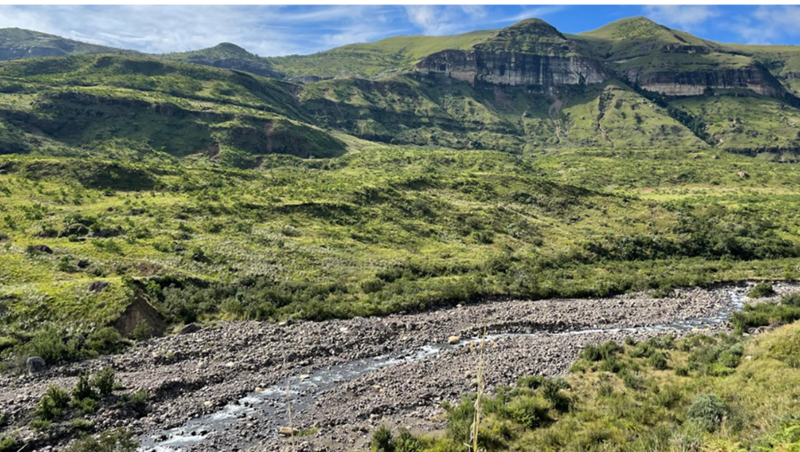
The diverse rivers of South Africa are shaped by geology, climate, and immense timescales. The Orange-Vaal system rises in the higher rainfall mountains of Lesotho, then flows through increasingly arid country. Its immense age is contrasted by its small contribution to the total national runoff today, demonstrating how river systems can persist through vast climatic changes. Other rivers, like the Berg and the Olifants in the southwest, are also incredibly ancient; their courses are traceable back more than 80 million years and are notable for their clear, cool, and acid ‘black’ waters. Their long history is evident in the distribution patterns of their aquatic animals, which reflect ancient connections and separations caused by past sea level changes. The remaining perennial rivers are much shorter, especially those along the eastern and southern coasts. These systems have cut deep gorges as coastal margins tilted and sea levels dropped in recent geological time. They are subject to enormous hydrological fluctuations. Eastern rivers tend to be warm and turbid (muddy), with neutral to slightly alkaline waters, while southcentral and southwestern rivers are typically clear and carry cool, acid, ‘black’ waters. The Pongola and other large rivers in KwaZulu-Natal form extensive, fertile floodplains in their lower reaches. Intermittent systems characterise the northern and northwestern regions of South Africa. They include seasonally intermittent rivers that cease to flow annually and ephemeral or episodic rivers that flow only after occasional rainfall events with available water reduced to standing pools.
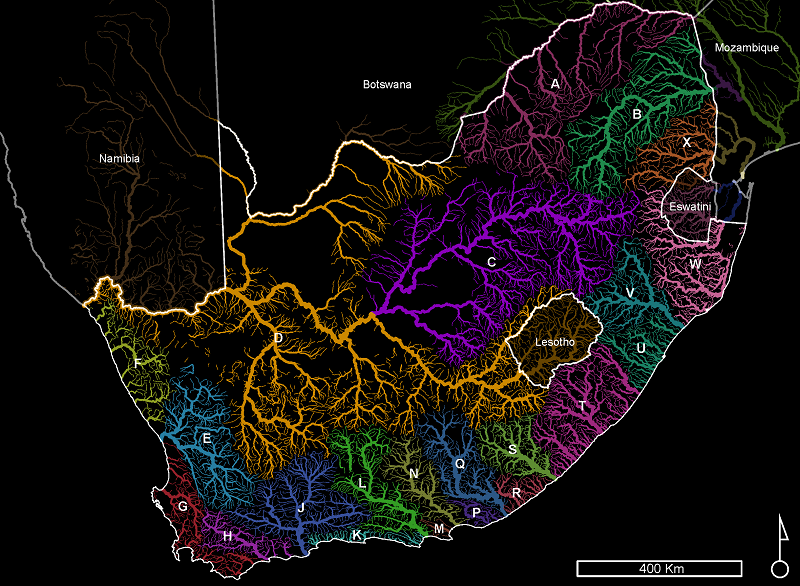
Mapping the river network
The network of river types for South Africa is the foundational input for assessing the status of rivers in the National Biodiversity Assessment. The river line network was used in order to align with the input dataset and results of the Water Research Commission and Department of Water and Sanitation joint project on the updated present ecological state and ecological importance and sensitivity of rivers. The river network remains the same base input dataset that was used for NBA 2018.
River ecosystem types
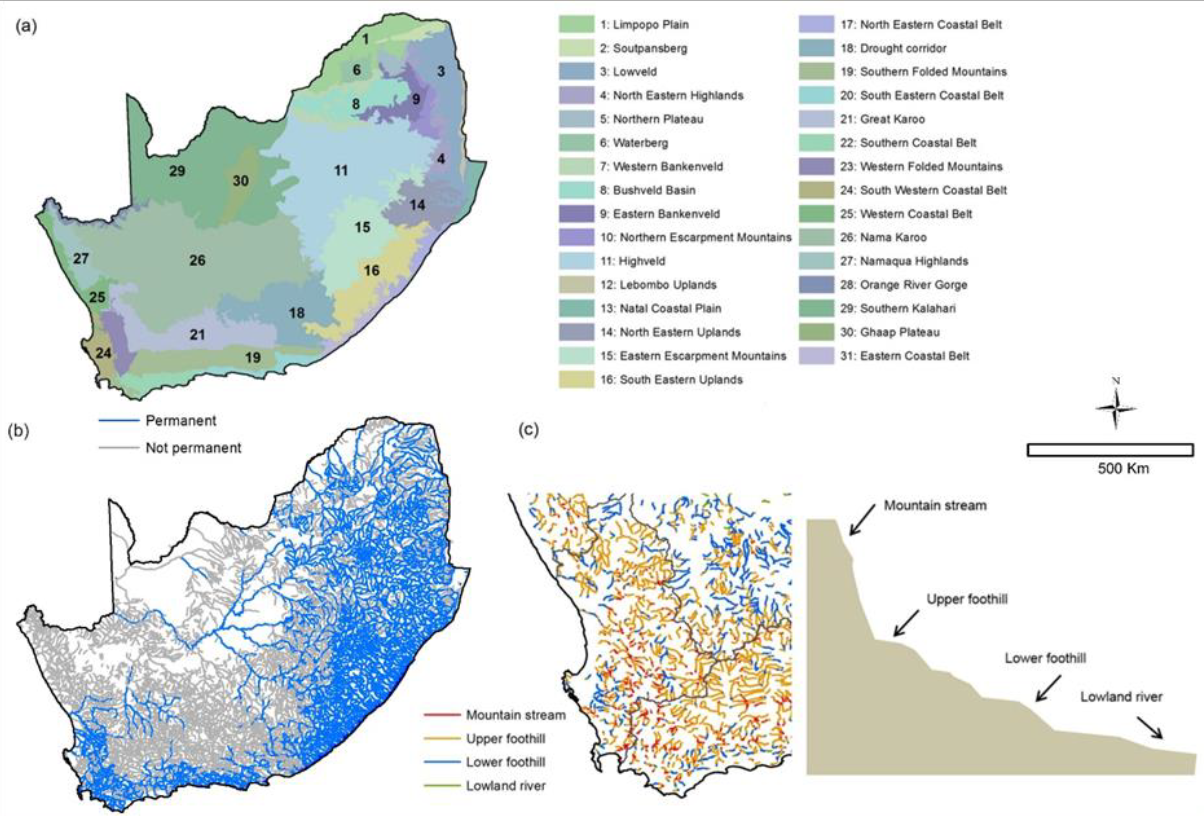
River ecosystem delineation and the classification system for the 2025 assessment remains largely unchanged from previous national assessments. The river network spatial layer was classified using 31 Level 1 ecoregions, flow variability (permanent or not permanent) and lumped geomorphological zones or slope categories (mountain stream, upper foothill, lower foothill and lowland river) to produce 222 distinct combinations of river ecosystem types1,2.
Ecoregions broadly characterise the landscape through which a river flows, such that rivers in the same ecoregion share similar broad ecological characteristics (e.g. topography, rainfall and geology).
South Africa’s river types have been aligned with the Global Ecosystem Typology to support reporting into global processes, including the following Ecosystem Functional Groups, F1.1 Permanent upland streams, F1.2 Permanent lowland rivers, F1.4 Seasonal upland streams, F1.5 Seasonal lowland rivers, and F1.6 Episodic arid rivers.
Future work
Converting the river line network into river area polygons has progressed significantly since the NBA 2018 assessment and will be available for future assessments. Work on riparian area mapping and typology is also underway and will be an exciting addition to future assessments. Gauteng province has undertaken a systematic update of their river network dataset, correcting flow direction, allocating up-to-date river order, expanding the database to include all significant tributary rivers, and indicating which rivers have been canalised or directed via underground pipes. North West and parts of the Western Cape provinces also have an updated river network dataset, with corrected flow direction, updated river order and an expanded inclusion of tributary river reaches. Updating of the river ecosystem types has been initiated and will continue to unfold over upcoming years, including validation of the river ecosystem types with species data and strengthened links to wetland and riparian ecosystem types.
Consideration of the impacts of climate change on river flow, temperature and sediment regime warrants investment in further research, including how these processes impact downstream estuarine, coastal and marine ecosystems. Strategic investment in improving our foundational knowledge will support our ability to offset risk and improve management.
An updated National Freshwater Ecosystem Priority Areas (NFEPA) project will be vital to consolidate the recent advances in freshwater information, operationalise inter-governmental cooperation and catchment-based planning and information sharing, and guide strategic and effective restoration and conservation action.
Technical documentation
Key publications
van Deventer, H., Smith-Adao, L., Nel, Jeanne L., Petersen, C., Raimondo, D. & van der Colff, D. 2019. Chapter 5: Input data used for the assessments. In: van Deventer et al. South African National Biodiversity Assessment 2018: Technical Report. Volume 2b: Inland Aquatic (Freshwater) Realm. CSIR report number CSIR/NRE/ECOS/IR/2019/0004/A. South African National Biodiversity Institute, Pretoria. http://hdl.handle.net/20.500.12143/6230.
Recommended citation
Job, N., Grenfell, M., Petersen, C., Smith-Adao, L., & Graham, E. 2026. River ecosystem types: Freshwater (inland aquatic) realm. National Biodiversity Assessment 2025. South African National Biodiversity Institute. http://nba.sanbi.org.za/.