
South Africa’s globally recognised biodiversity richness also extends to inland wetlands. A wide range of climatic, geological and topographic settings have resulted in an exceptional diversity of wetland ecosystem types, from permanently saturated peatlands which accumulated in place over thousands of years, to ephemeral salt pans harbouring newly described aquatic invertebrate species. More than half of South Africa’s wetlands are less than two hectares in size but are of outsized importance when functioning collectively across a catchment, especially within the semi-arid context. Wetlands improve water quality and control floods, and they are water sources, habitats, and refuges for animals and people in times of drought, among many other benefits.
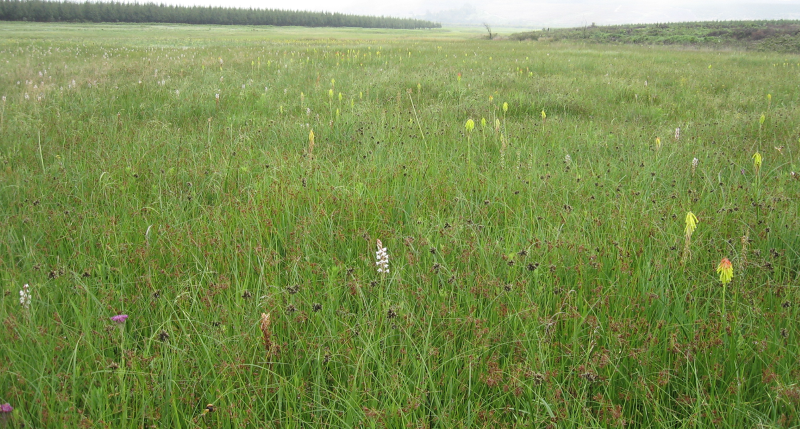
South Africa is one of the most water-scarce countries in the world, with high temporal and spatial variability in rainfall. Evapotranspiration significantly exceeds rainfall over most of the country. Despite this inherent scarcity, diverse geology, topography, highly variable catchments and river flow regimes have resulted in a rich variety of inland wetlands. The persistent diversity of these inland wetland ecosystem types is underpinned strongly contrasting bioclimatic zones, including the arid western interior and mesic eastern grassy biomes (both summer rainfall), as well as the arid western coastal regions and the mesic southwestern Cape (winter rainfall).
Mapping wetland extent
The National Wetland Map (NWM) is the primary input layer for the NBA 2025. The map depicts the location and extent of wetlands and strives to capture the historical extent of wetlands prior to human modification. The map is created using a mixed-method approach combining diverse data sources and mapping techniques to achieve comprehensive coverage and accuracy. This methodology integrates traditional data collection, ranging from field mapping and the digitisation of satellite imagery, to information derived from Earth Observation, supported by automated processes. Notably, the map has incorporated an automated wetland probability map, which uses topographic modelling to estimate wetland likelihood and efficiently map large or previously unmapped areas. Furthermore, the dataset is enriched by important contributions from external stakeholders. To manage this complexity, the NWM team developed a robust framework and established protocols for standardising, preparing, and integrating data from these varied methods and contributors into a single, cohesive, and consolidated national dataset.
Classifying wetland types – a work in progress
An interim typology of South Africa’s wetland ecosystem types, based on a combination of bioregional and hydrogeomorphic criteria, informs NBA 2025. Wetlands are first classified according to hydrogeomorphic type based on landform and hydrology1,2. Four hydrogeomorphic (HGM) types have been adopted for the NBA 2025 assessment. These are floodplain wetlands (identified by the presence of a river channel and consolidating previously named floodplain and channelled valley-bottom wetlands into one group), unchannelled valley-bottom wetlands, depression wetlands and seep wetlands. The four HGM types are further divided into regional wetland types, resulting in 82 provisional types.
Each wetland type has been aligned with the Global Ecosystem Typology to support reporting into global processes, with depression wetlands grouped under F2 Lacustrine wetlands, and all other inland wetlands grouped under TF1 Palustrine wetlands.
Future work
While the current working version of the national wetland ecosystem map will be released alongside NBA 2025 as National Wetland Map 2025, mapping efforts with a range of partners continue, focused on filling data gaps and expanding the map coverage. We are actively developing an updated wetland typology with accompanying descriptions of each wetland ecosystem type (a first for South Africa). Extensive efforts with multiple partners to revise the wetland typology was not finalised for inclusion in the NBA 2025 materials. This work will continue into the upcoming year, expanding the current number of wetland ecosystem types and moving closer towards a comprehensive ecosystem map. It remains essential that map data be verified in the field by wetland professionals for site-specific conservation and management decisions.
Technical documentation
Key publications
Convention on Wetlands. 2025. Small wetlands: Their importance and strategies for effective conservation. Policy Brief 7. Gland, Switzerland: Secretariat of the Convention on Wetlands.
Grenfell, S., Grenfell, M., Ellery, W., Job, N. & Walters, D. 2019. A genetic geomorphic classification system for southern African palustrine wetlands: Global implications for the management of wetlands in drylands. Frontiers in Environmental Science 7:174. doi: 10.3389/fenvs.2019.00174
Ollis, D.J., Snaddon, C.D., Job, N.M. & Mbona, N. 2013. Classification system for wetlands and other aquatic ecosystems in South Africa. User manual: Inland systems. SANBI Biodiversity Series 22. South African National Biodiversity Institute, Pretoria.
Recommended citation
Job, N., Grenfell, S., Ollis, D., Kotze, D., Collins, N.B., Awuah, A., & Sieben, E. 2026. Wetland ecosystem types: Freshwater (inland aquatic) realm. National Biodiversity Assessment 2025. South African National Biodiversity Institute. http://nba.sanbi.org.za/.