
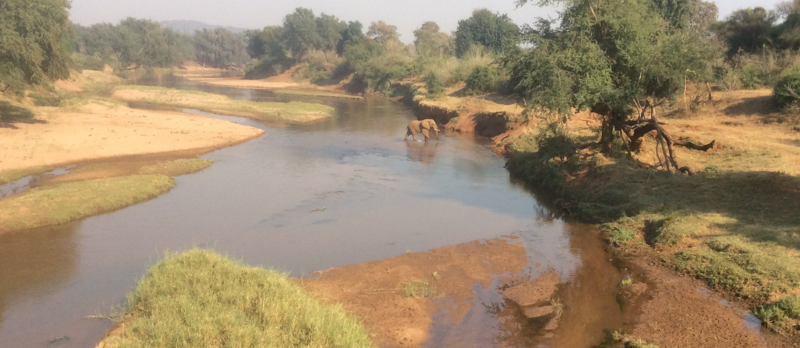
Rivers are among the most threatened ecosystems in South Africa, with over 65% of river types categorised as Threatened. This places the vital ecosystem services they provide and the incredible biodiversity they support at great risk.
65%
of river length
Threatened
of river length
Threatened
65%
of 222 river ecosystem types
Threatened
of 222 river ecosystem types
Threatened
Of South Africa’s 222 river ecosystem types, 22% (49) are Critically Endangered, 19% (44) are Endangered, 23% (52) are Vulnerable, and 34% (77) are of Least Concern. In terms of total river length, 2% is Critically Endangered, 6% Endangered, 56% Vulnerable, and 34% is of Least Concern.
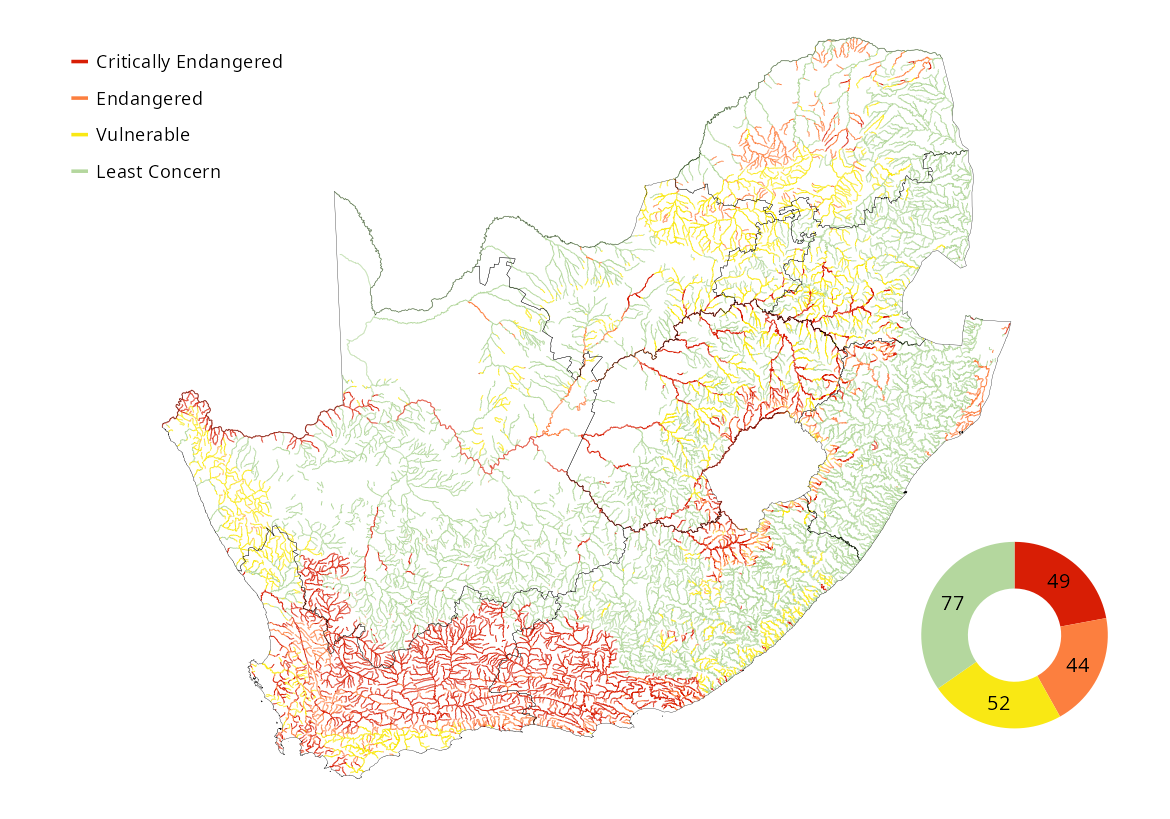
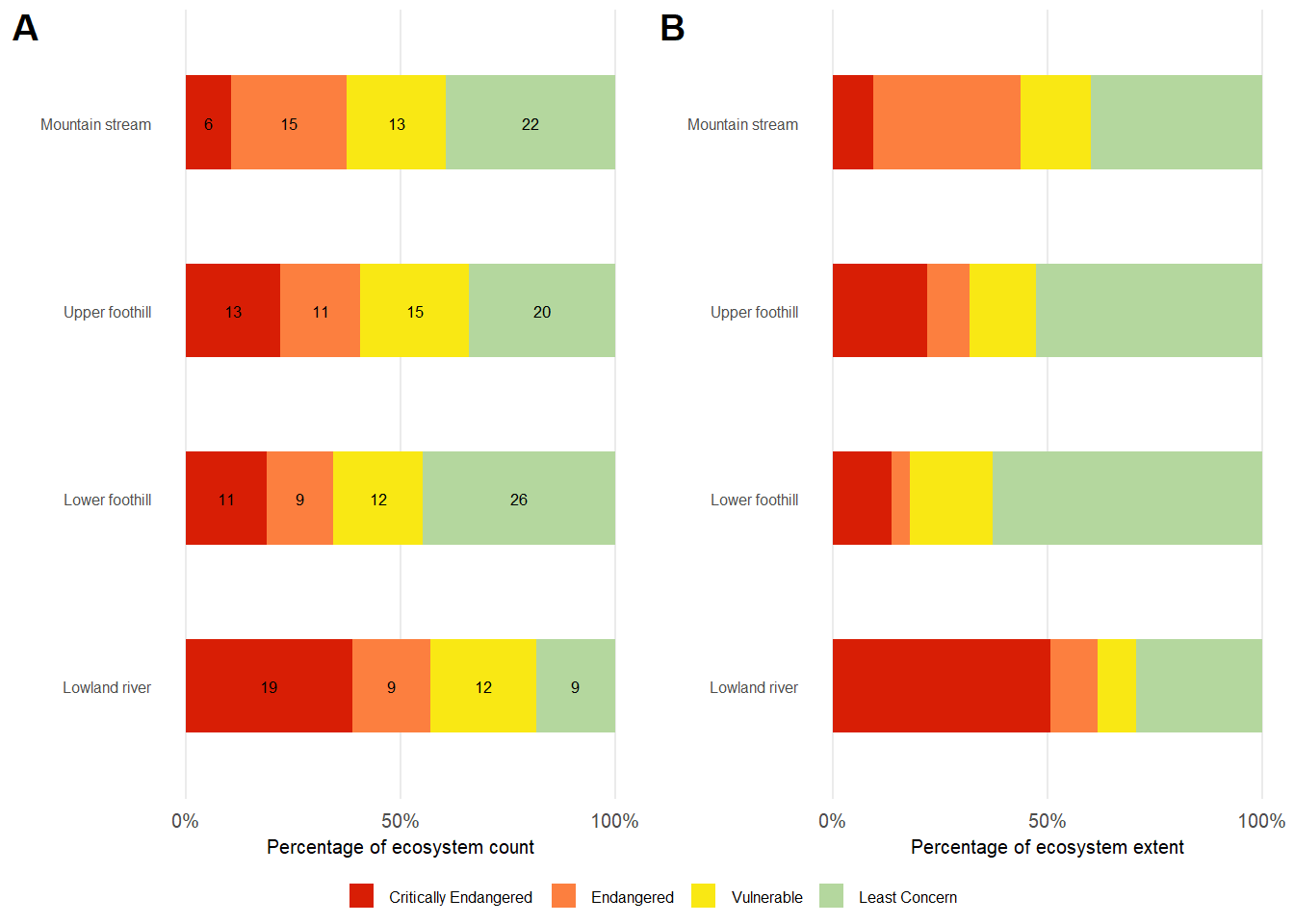
Ecosystem threat status varies across geomorphological zones with 67% of lowland river types being Critically Endangered compared to only 25% of mountain stream types.
| Critically Endangered | Endangered | Vulnerable | Least Concern | ||
|---|---|---|---|---|---|
| Mountain stream | Count | 6 | 15 | 13 | 22 |
| Extent (km) | 640 | 2 352 | 1 113 | 2 716 | |
| Upper foothill | Count | 13 | 11 | 15 | 20 |
| Extent (km) | 16 833 | 7 616 | 11 855 | 40 269 | |
| Lower foothill | Count | 11 | 9 | 12 | 26 |
| Extent (km) | 10 269 | 3 199 | 14 559 | 47 100 | |
| Lowland river | Count | 19 | 9 | 12 | 9 |
| Extent (km) | 10 643 | 2 348 | 1 884 | 6 128 | |
Download the data here.
Important note on work in progress
The river threat status assessment applied the IUCN Red List of Ecosystems framework for the first time. Given the application of a new method and input data, the current results are considered preliminary and a more extensive review of the outputs is still to be completed, with stakeholder engagement continuing through early 2026. It is likely to result in adjustments and an updated assessment, which will be widely communicated.
Approach
Ecosystem threat status is a headline indicator established to assess how close an ecosystem type is to collapsing (losing vital aspects of its structure, function, or composition). It serves as an indicator of the degree to which ecosystems are still intact.
Key input layers include river ecosystem types and river ecological condition.
The assessment was conducted using the IUCN Red List of Ecosystems framework (version 2), which has been applied across all realms for the 2025 assessments. The framework uses the concept of ecosystem collapse as the equivalent endpoint to species extinction. It evaluates the status of each ecosystem type using a set of quantitative and qualitative criteria linked to the key aspects of ecosystem decline, namely, Criterion A: reduction in extent, Criterion B: restricted distribution, Criterion C: environmental degradation and Criterion D: biotic degradation. Read more about this indicator on the ecosystem threat status explainer page.
The IUCN RLE (version 2) approach was followed and the following criteria were assessed for river ecosystems:
Criterion B1aiii was applied using extent of occupancy calculations with ongoing decline defined as an increase in the extent of D,E and F condition river length from the previous PES assessment period.
Criterion D2b was applied using the rate of change in condition between 2018 and 2024, projected forward to 2068 (a 50 year period).
Criterion D3 was applied to the Present Ecological State (PES) data such that Severity >=90% was assigned to PES classes E-F; Severity >=70% was assigned to PES classes D-F; Severity >=50% was assigned to PES classes C-F.
Each river ecosystem type was assessed against these criteria and the highest risk category triggered by any single criterion was assigned as the overall ecosystem threat status for that type. Each of the 222 river ecosystem types was placed into one of four risk categories: Critically Endangered, Endangered, Vulnerable, or Least concern. Critically endangered, endangered, and vulnerable are collectively referred to as the threatened categories.
Technical documentation
Code repository
Skowno, A.L. 2025. SANBI-NBA Wetland ecosystem threat status [Source code]. GitHub repository available at https://github.com/askowno/RLE_riv
Key publications
Harris, L.R., Skowno, A.L., Holness, S.D., Sink, K.J., van Niekerk, L., van Deventer, H., Smith-Adao, L., Job, N., Khatieb, S., Monyeki, M. (in review). Indicators for tracking progress in effective, representative ecosystem protection.
Recommended citation
Job, N., Skowno, A., & Currie, J. 2026. River ecosystem threat status: Freshwater (inland aquatic) realm. National Biodiversity Assessment 2025. South African National Biodiversity Institute. http://nba.sanbi.org.za/.