Ecological condition

Estuarine realm

Lara van Niekerk1, 2 , Susan Taljaard1, 2 , Janine B. Adams3, 2 , Stephen J. Lamberth4, 2 , Fiona C. Mackay5, 6 , Steven P. Weerts1, 7 , Daniel A. Lemley2 , Nicola C. James8, 2 , Gavin M. Rishworth2, 3 , Jane K. Turpie9 , Jabulile Nhleko4 , Chuene P. Lakane2, 3

1. Council for Scientific and Industrial Research

2. Institute for Coastal and Marine Research, Nelson Mandela University

3. DST/NRF Research Chair in Shallow Water Ecosystems, Nelson Mandela University

4. Department of Environment, Forestry and Fisheries

5. Oceanographic Research Institute, SAAMBR

6. University of KwaZulu-Natal

7. University of Zululand

8. South African Institute for Aquatic Biodiversity

9. Anchor Environmental Consultants

Published

December 5, 2025

More than 53% of South Africa’s estuaries are relatively healthy, but this amounts to only 18% of total estuarine extent, comprised mostly of small estuaries. Concerning the overall, more than 70% of estuarine area is significantly modified.

This represents an overall 3% decline in Natural/Near Natural estuaries and 7% increase in degraded extent. Important ecological processes are under severe pressure and with resultant reductions in ecosystem productivity, food security, fisheries livelihood, property values and recreational enjoyment.
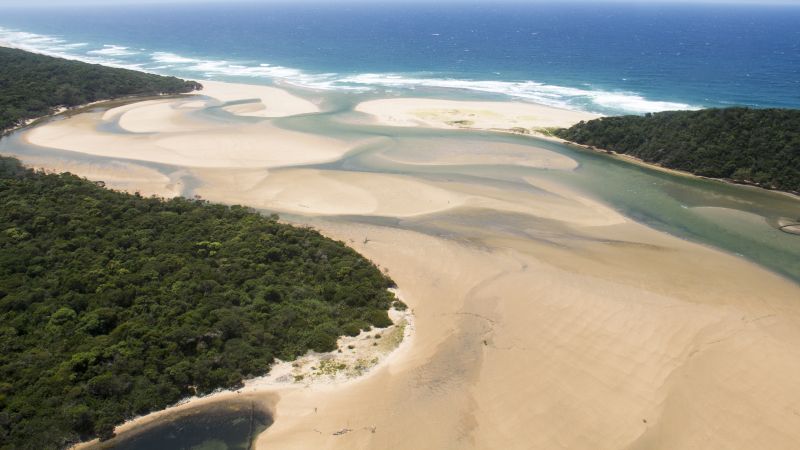
Kosi Estuary is an example of a Tropical Estuarine Lake in a Near-natural state is an example of healthy productive estuary that support biodiversity and coastal livelihoods. (© iSimangaliso Wetland Park)
53%
of estuaries
Natural/near natural
22%
of estuaries
Heavily to critically degraded
18%
of estuarine area
Natural/near natural
70%
of estuarine area
Heavily to critically degraded

South African estuaries differ considerably around the coast in terms of their physicochemical and biotic characteristics. The climatic range across the four biogeographic regions has resulted in large differences in human settlement patterns and with them the nature of estuarine utilisation1. The first step in proactive planning and effective management of estuaries is to understand how healthy they are.

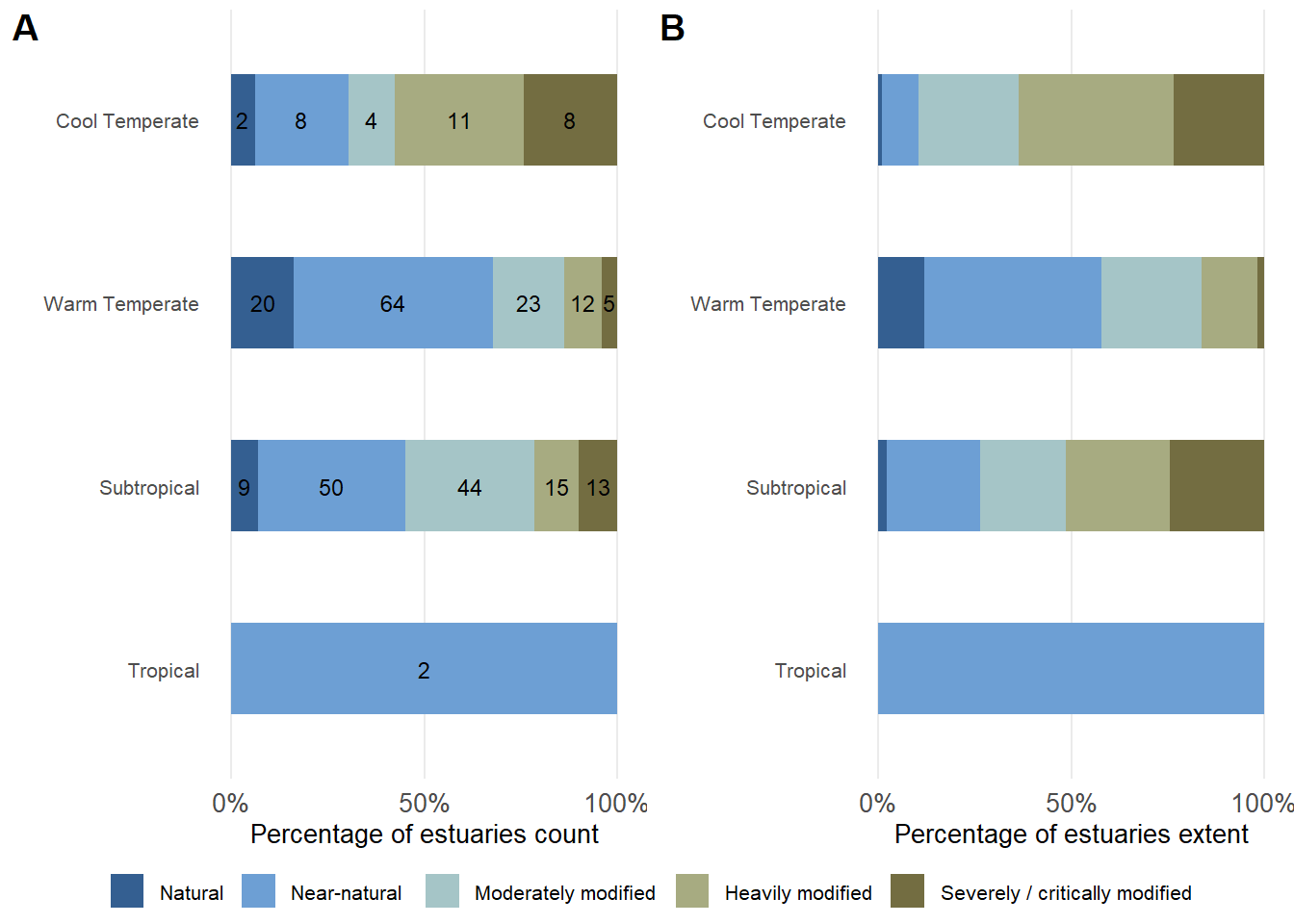
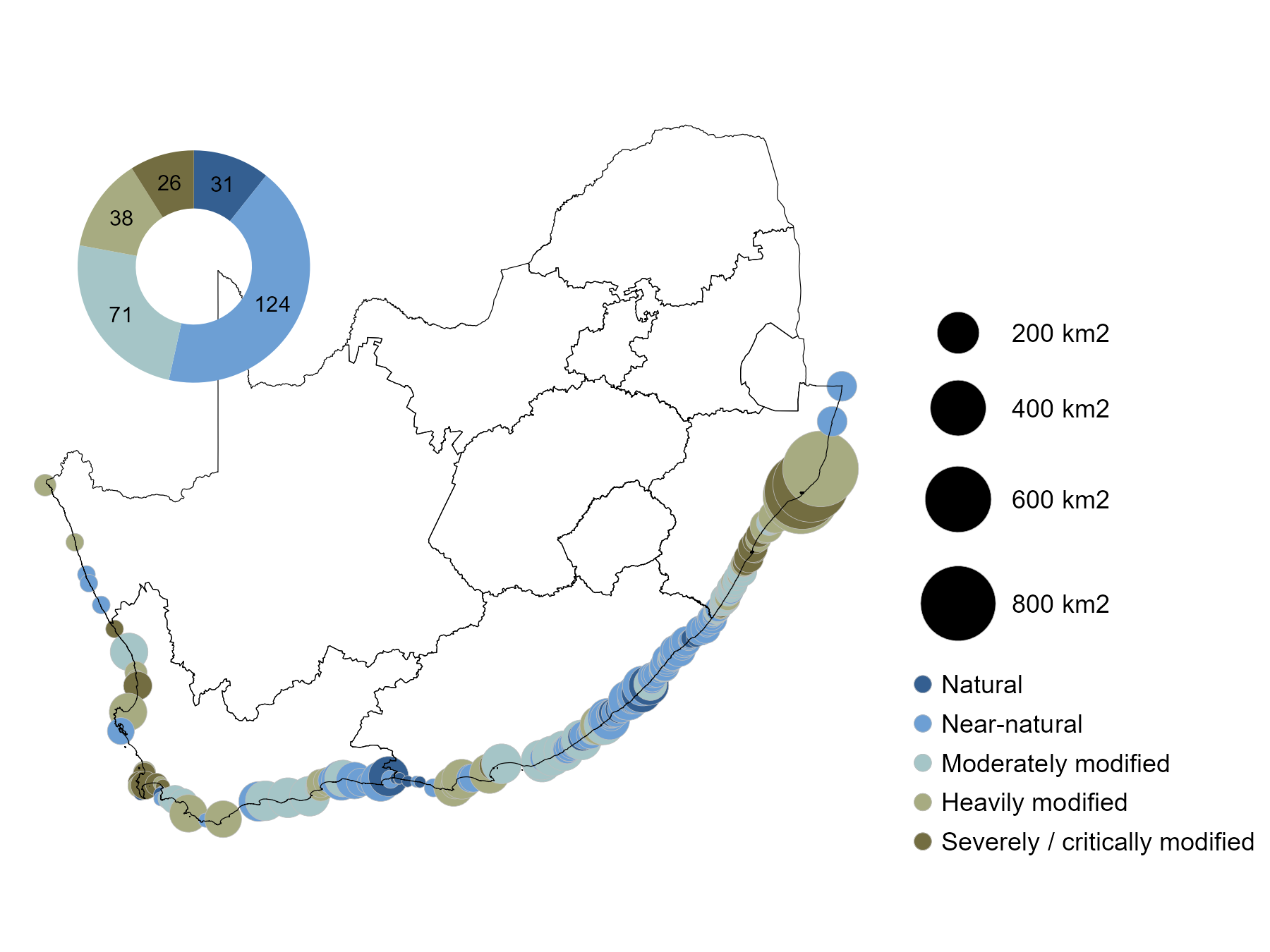
The 2025 assessment determined that 11% of estuaries in South African are considered to be in a Natural state (A category), 43% in a Near natural state (B category), 28% in a Moderately modified state (C category), 8% in a Heavily modified state (D category), and 7% in a Severely/Critical modified state. Estuaries in Natural and Near natural state are mainly located in the Warm Temperate and Subtropical regions, while the Cool Temperate region is characterised by estuaries in a Heavily to Severely /Critical modified state. That analysis is biased towards the state of the large number of small estuary types occurring along the South African coast. When analysed according to estuarine area rather than the number of estuaries, the majority (70%) of estuarine area is in a Heavily modified state or worse, and only about 1% and 18% in a Natural and Near natural state, respectively. The latter are mainly located in the Warm Temperate region and Subtropical region. An additional 12% are in a moderately modified state. Part of this result is an artefact of the ‘Lake St Lucia effect’. This Subtropical system accounts for more than half of South African estuarine extent and is currently classified as being in a Heavily modified state.

The 2018 assessment showed that 21% of estuaries in a Natural state, 40% in a Near natural state, 20% in a Moderately modified state, 12% in a Heavily modified state, and 7% in a Severely /Critical modified state. By estuarine area, the majority of estuarine area (63%) was in a Heavily modified state or worse, and only about 5% and 17% in a Natural and Near natural state, respectively.

The Cool Temperate region had the highest number of estuaries in a degraded condition as it supports estuarine habitat mainly in the Severely to Critical modified categories, especially the large to small temporarily open systems near Cape Town and other coastal urban centres. The Warm Temperate region, on the other hand, was characterised by a large number of estuaries in a Natural to Near Natural condition, possibly due to the undeveloped nature of large parts of the coast in this biogeographic region. The Subtropical region had the second-highest number of estuaries in a degraded state, mainly due to pollution, very high fishing pressure (illegal gillnetting), direct habitat loss, sand mining, and intensive sugar cane farming in the catchments and estuary functional zone.

Figure 1. Map of estuary degradation showing the spatial distribution of estuaries in natural/near natural, moderately degraded, severely degraded or critically degraded state.

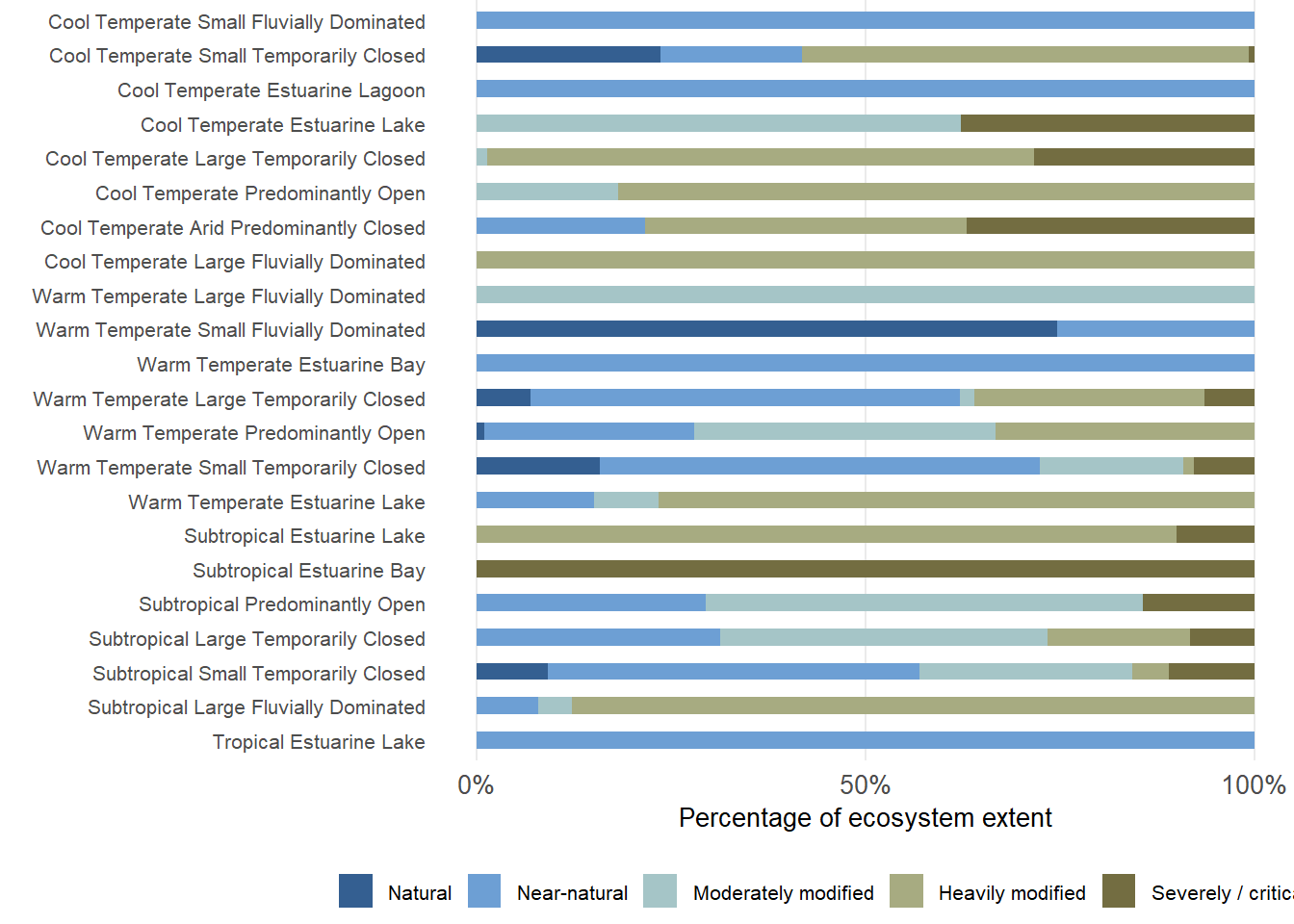
From an Estuarine Ecosystem perspective, the Cool Temperate biogeographical region had the highest percentage of ecosystem types in a Heavily to Severely/critically modified state with Large fluvially dominated, Large temporarily Closed, Arid predominantly closed, Small temporarily closed and Estuarine Lakes reflecting key pressures such as flow reduction, pollution and fishing pressure of the region.

This group of estuaries has seen extensive infrastructure development in the estuary functional zone, substantial flow reduction, nutrient pollution, harmful algal blooms, overfishing (especially gillnetting) and are subjected to artificial breaching / mouth manipulation. In addition, the lakes are highly vulnerable to climate change. These impacts have reduced their ability to provide key services such as flood regulation, nutrient cycling, nursery habitat, and have compromised recreational and tourism values.

The first record of estuarine lake acidification in South Africa was observed the last ten years. The Verlorenvlei Ramsar site’s pH levels declined to 3 (similar to vinegar) during the period 2016-18 due to a regional drought compounded by over-abstraction of surface and groundwater, causing the drying out of the lake and acidification of soils. This caused the local extinction of invertebrates, fish and bird life. Though lake levels have recovered over the past 3 years, lake pH has still fluctuated for three years between 4 (summer) and 7 (winter). It may take decades for the Ramsar site to fully recover, given the altered soil chemistry in the lake and surrounding wetlands. Manage surface and groundwater allocation to ensure ecosystem resilience during droughts, reduce nutrient pollution, to reduce the buildup of organic material (agricultural return flow).
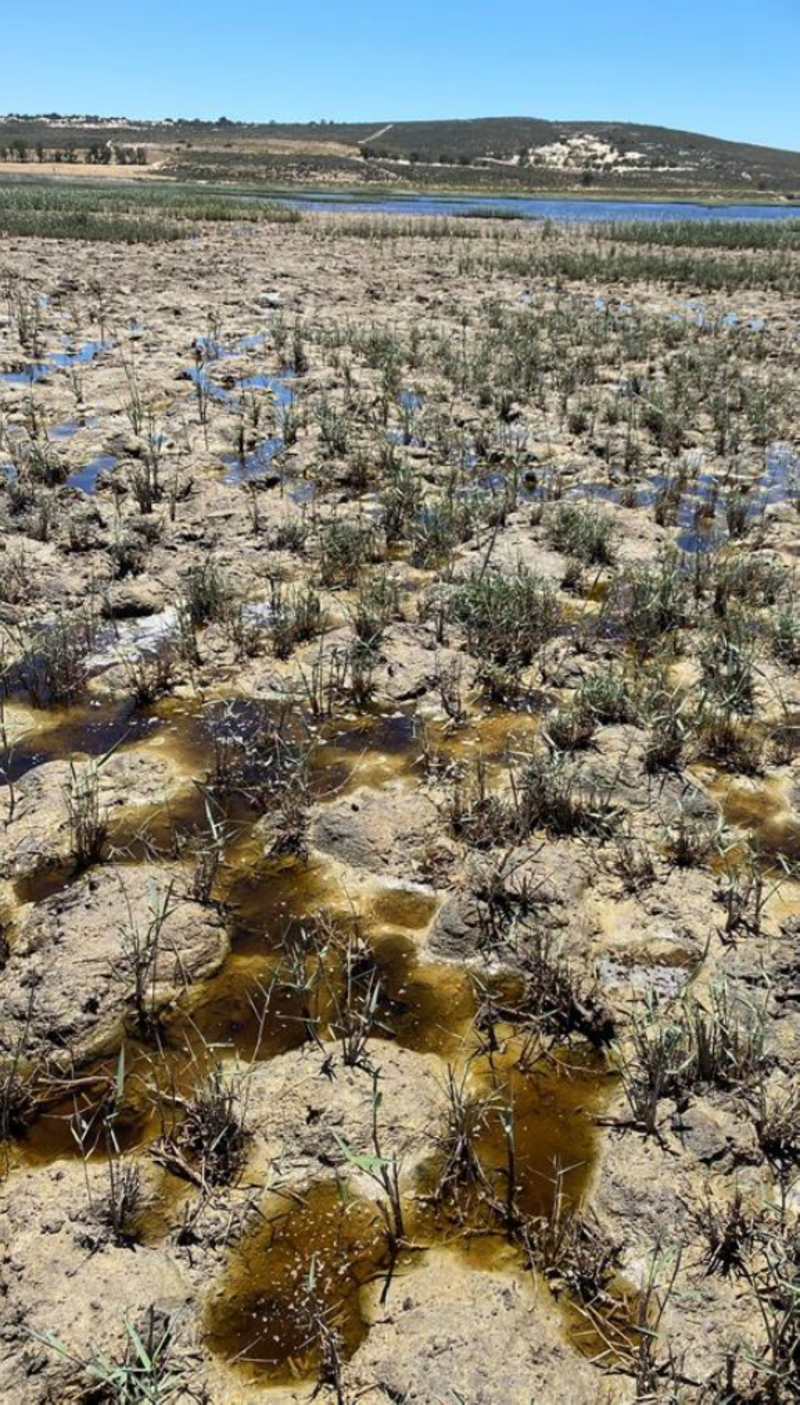
The first record of estuarine lake acidification in South Africa was observed at Verlorenvlei Estuarine Lake. (© Lara van Niekerk)

To ensure ecosystem benifits and future climate change resilience, a long-term ‘Estuarine Lakes Strategy’ is needed to restore habitat, improve water quantity and quality, reduce pressure on resources and increase protection levels. .

In the Subtropical biogeographical region, the highest number of ecosystem types in a Heavily to Severely/Critical modified state are the Estuarine lakes, Estuarine bay, and Large fluvially dominated functional groups reflecting habitat transformation, pollution and fishing pressure of the region. In the Warm Temperate region, the Estuarine lakes reflect significant degradation due to development in the estuarine functional zone, flow reduction and artificial breaching. In addition, Predominantly open and Large temporarily open estuaries are also significantly degraded. None of the types in the Tropical biogeographical region is in a severely degraded state.

Figure 2. Different perspectives arise when the condition assessment is presented either as “Percentage estuaries” or “Percentage estuarine extent”. The area analysis highlights the fact that the majority of South African estuarine extent is in a degraded state.
Figure 3. Ecosystem type condition express as percentage of estuarine extent
Table 1. The condition of South Africa’s estuaries presented as number of estuaries, extent, percentage of eestuary extent
Natural Near-natural Moderately modified Heavily modified Severely / critically modified
Cool Temperate No. estuaries 2 8 4 11 8
Extent (km2) 10 119 327 506 293
Percentage (%) 1 9 26 40 23
Warm Temperate No. estuaries 20 64 23 12 5
Extent (km2) 995 3 877 2 200 1 229 134
Percentage (%) 12 46 26 15 2
Subtropical No. estuaries 9 50 44 15 13
Extent (km2) 184 2 084 1 909 2 315 2 107
Percentage (%) 2 24 22 27 24
Tropical No. estuaries 0 2 0 0 0
Extent (km2) 0 163 0 0 0
Percentage (%) 0 100 0 0 0

Overall, a significant number of the estuaries in South Africa are in excellent to good health, but these are mostly small systems in rural areas with few pressures. In these areas, smaller estuaries tend to be in a better state of health because there are fewer pressures on them. However, these systems tend not to be as resilient to change as large estuaries, primarily due to their small size and higher residence time brought about by limited tidal exchange. This is one of the key reasons for the poor conditions of urban systems.

On the other hand, larger systems, which are important as fish nursery grounds and of higher economic and ecological importance, are mostly in declining health due to indirect pressures from the catchment and direct pressures such as development in the estuary functional zone and fishing. Most of the estuarine extent in South Africa is in a modified moderately to heavily modified state and there is a risk that this percentage could increase further if appropriate management actions are delayed.

The St Lucia Lake System accounts for more than half of the estuarine extent in South Africa and it is in relatively poor condition. Fortunately, however, the St Lucia and uMfolozi systems are in the process of being restored, and an adaptive management and monitoring programme has been initiated to assist with the long-term recovery of this World Heritage Site.

Monitoring of both abiotic and biotic parameters is seen as fundamental to validating the findings of the condition assessment. To benchmark the findings, monitoring also needs to cover the full spectrum of near-natural to heavily degraded estuaries in all four bioregions following the standardised methods developed for flow requirement studies. Ideally, research and assessment should be underpinned by modelling studies that encompass the functional linkages between ecosystem components and overwhelming pressures on the environment, such as Climate Change and ocean acidification. Such modelling studies can provide the evidence needed for setting realistic targets for resource use, and can also underpin better long-term resource planning.

NoteBox 2. Invest in solutions to restore estuarine ecological infrastructure to sustain ecosystem services and strengthen climate resilience.

The United Nations Decade of Ecosystems Restoration 2021-2030 makes restoration and protection of critical ecosystems an imperative at a global scale. This call to arms aims to scale up the restoration of degraded ecosystems to combat the climate crisis and enhance food security and biodiversity. It also presents a host of funding opportunities through climate finance instruments (e.g. Blue Carbon trading), Ecosystems-based Adaptation (EbA) global funds, and national debt restructuring mechanisms, which will be highly supportive of a South African Strategic Estuarine Management Framework.

In response, restoration projects have been initiated at a few key estuary sites in South Africa, e.g. St Lucia, Groot Berg, Swartkops, and uMlalazi. Ongoing research has also identified critical systems (e.g. Orange, Olifants, Klein Brak, Gamtoos) that will ensure the best return on investment.

DFFE and the provincial authorities are engaging in an ‘Estuary Restoration Programme’ that focuses on degraded and novel systems with an emphasis on the larger systems of high biodiversity importance and the socially important urban systems. Here, an opportunity exists for flagship programmes that could be developed in a collaborative manner between government agencies and civil society. A national estuarine restoration programme will also have the advantage of securing long-term funding at regional scales. Local and provincial government, conservation agencies and NGOs should assist in initiating site-specific restoration opportunities (e.g. BirdLife at Groot Berg).

Table 2. Estuary Condition for South Africa listed by estuary
Estuary name Estuary type Condition
Orange Cool Temperate Large Fluvially Dominated Heavily modified
Buffels Cool Temperate Arid Predominantly Closed Heavily modified
Swartlintjies Cool Temperate Arid Predominantly Closed Near-natural
Spoeg Cool Temperate Arid Predominantly Closed Near-natural
Groen Cool Temperate Arid Predominantly Closed Near-natural
Sout (Noord) Cool Temperate Arid Predominantly Closed Severely / critically modified
Olifants Cool Temperate Predominantly Open Moderately modified
Jakkals Cool Temperate Large Temporarily Closed Heavily modified
Wadrift Cool Temperate Arid Predominantly Closed Heavily modified
Verlorenvlei Cool Temperate Estuarine Lake Severely / critically modified
Groot Berg Cool Temperate Predominantly Open Heavily modified
Langebaan Cool Temperate Estuarine Lagoon Near-natural
Diep/Rietvlei Cool Temperate Large Temporarily Closed Heavily modified
Sout (Wes) Cool Temperate Large Temporarily Closed Severely / critically modified
Disa Cool Temperate Large Temporarily Closed Severely / critically modified
Wildevoëlvlei Cool Temperate Large Temporarily Closed Heavily modified
Schuster Cool Temperate Small Temporarily Closed Near-natural
Krom Cool Temperate Small Temporarily Closed Natural
Silwermyn Cool Temperate Large Temporarily Closed Severely / critically modified
Zand Cool Temperate Large Temporarily Closed Heavily modified
Zeekoei Cool Temperate Estuarine Lake Severely / critically modified
Eerste Cool Temperate Large Temporarily Closed Severely / critically modified
Lourens Cool Temperate Small Temporarily Closed Heavily modified
Sir Lowry’s Pass Cool Temperate Small Temporarily Closed Severely / critically modified
Steenbras Cool Temperate Small Fluvially Dominated Near-natural
Rooiels Cool Temperate Small Temporarily Closed Natural
Buffels (Oos) Cool Temperate Small Temporarily Closed Near-natural
Palmiet Cool Temperate Large Temporarily Closed Moderately modified
Bot/Kleinmond Cool Temperate Estuarine Lake Moderately modified
Onrus Cool Temperate Small Temporarily Closed Heavily modified
Klein Cool Temperate Estuarine Lake Moderately modified
Uilkraals Cool Temperate Predominantly Open Heavily modified
Ratel Cool Temperate Small Temporarily Closed Near-natural
Heuningnes Warm Temperate Estuarine Lake Heavily modified
Klipdrifsfontein Warm Temperate Small Temporarily Closed Natural
Breede Warm Temperate Predominantly Open Near-natural
Duiwenhoks Warm Temperate Predominantly Open Moderately modified
Goukou Warm Temperate Predominantly Open Moderately modified
Gouritz Warm Temperate Predominantly Open Moderately modified
Blinde Warm Temperate Small Temporarily Closed Moderately modified
Tweekuilen Warm Temperate Small Temporarily Closed Severely / critically modified
Gericke Warm Temperate Small Temporarily Closed Severely / critically modified
Hartenbos Warm Temperate Large Temporarily Closed Heavily modified
Klein Brak Warm Temperate Large Temporarily Closed Heavily modified
Groot Brak Warm Temperate Large Temporarily Closed Heavily modified
Maalgate Warm Temperate Large Temporarily Closed Near-natural
Gwaing Warm Temperate Small Temporarily Closed Moderately modified
Kaaimans Warm Temperate Predominantly Open Near-natural
Touw/Wilderness Warm Temperate Estuarine Lake Moderately modified
Swartvlei Warm Temperate Estuarine Lake Near-natural
Goukamma Warm Temperate Large Temporarily Closed Near-natural
Knysna Warm Temperate Estuarine Bay Near-natural
Noetsie Warm Temperate Small Temporarily Closed Near-natural
Piesang Warm Temperate Large Temporarily Closed Heavily modified
Keurbooms Warm Temperate Predominantly Open Near-natural
Matjies Warm Temperate Small Temporarily Closed Near-natural
Sout (Oos) Warm Temperate Predominantly Open Natural
Groot (Wes) Warm Temperate Small Temporarily Closed Near-natural
Bloukrans Warm Temperate Small Fluvially Dominated Natural
Lottering Warm Temperate Small Fluvially Dominated Natural
Elandsbos Warm Temperate Small Fluvially Dominated Natural
Storms Warm Temperate Small Fluvially Dominated Natural
Elands Warm Temperate Small Fluvially Dominated Near-natural
Groot (Oos) Warm Temperate Small Fluvially Dominated Natural
Tsitsikamma Warm Temperate Small Temporarily Closed Near-natural
Klipdrif (Oos) Warm Temperate Small Temporarily Closed Moderately modified
Slang Warm Temperate Small Temporarily Closed Moderately modified
Kromme Warm Temperate Predominantly Open Heavily modified
Seekoei Warm Temperate Large Temporarily Closed Heavily modified
Kabeljous Warm Temperate Large Temporarily Closed Near-natural
Gamtoos Warm Temperate Predominantly Open Heavily modified
Van Stadens Warm Temperate Large Temporarily Closed Near-natural
Maitland Warm Temperate Large Temporarily Closed Near-natural
Baakens Warm Temperate Small Temporarily Closed Severely / critically modified
Papkuils Warm Temperate Small Temporarily Closed Severely / critically modified
Swartkops Warm Temperate Predominantly Open Heavily modified
Coega (Ngqurha) Warm Temperate Large Temporarily Closed Severely / critically modified
Sundays Warm Temperate Predominantly Open Moderately modified
Boknes Warm Temperate Small Temporarily Closed Moderately modified
Bushmans Warm Temperate Predominantly Open Moderately modified
Kariega Warm Temperate Predominantly Open Moderately modified
Grant's Warm Temperate Small Temporarily Closed Moderately modified
Kasouga Warm Temperate Large Temporarily Closed Near-natural
Kowie Warm Temperate Predominantly Open Moderately modified
Rufane Warm Temperate Small Temporarily Closed Moderately modified
Riet Warm Temperate Small Temporarily Closed Near-natural
West Kleinemonde Warm Temperate Large Temporarily Closed Near-natural
East Kleinemonde Warm Temperate Large Temporarily Closed Near-natural
Great Fish Warm Temperate Predominantly Open Moderately modified
Old Woman’s Warm Temperate Large Temporarily Closed Moderately modified
Mpekweni Warm Temperate Large Temporarily Closed Near-natural
Mtati (Mthathi) Warm Temperate Large Temporarily Closed Near-natural
Mgwalana Warm Temperate Large Temporarily Closed Near-natural
Bira (Bhirha) Warm Temperate Large Temporarily Closed Near-natural
Gqutywa Warm Temperate Large Temporarily Closed Near-natural
Ngculura (Ngculurha) Warm Temperate Small Temporarily Closed Near-natural
Mtana Warm Temperate Small Temporarily Closed Near-natural
Keiskamma Warm Temperate Predominantly Open Moderately modified
Nqinisa Warm Temperate Small Temporarily Closed Natural
Kiwane (Khiwane) Warm Temperate Large Temporarily Closed Natural
Tyolomnqa Warm Temperate Large Temporarily Closed Near-natural
Shelbertsstroom Warm Temperate Small Temporarily Closed Near-natural
Lilyvale Warm Temperate Small Temporarily Closed Near-natural
Ross' Creek Warm Temperate Small Temporarily Closed Near-natural
Ncera (Ncerha) Warm Temperate Large Temporarily Closed Near-natural
Mlele Warm Temperate Small Temporarily Closed Near-natural
Mcantsi Warm Temperate Small Temporarily Closed Moderately modified
Gxulu Warm Temperate Large Temporarily Closed Moderately modified
Goda Warm Temperate Large Temporarily Closed Near-natural
Hlozi Warm Temperate Small Temporarily Closed Near-natural
Hickman's Warm Temperate Small Temporarily Closed Moderately modified
Buffalo Warm Temperate Predominantly Open Heavily modified
Blind Warm Temperate Small Temporarily Closed Heavily modified
Hlaze (iHlanze) Warm Temperate Small Temporarily Closed Heavily modified
Nahoon Warm Temperate Predominantly Open Moderately modified
Qinira (Quinirha) Warm Temperate Large Temporarily Closed Near-natural
Gqunube Warm Temperate Predominantly Open Near-natural
Kwelera (Kwelerha) Warm Temperate Predominantly Open Near-natural
Bulura (Bulurha) Warm Temperate Large Temporarily Closed Near-natural
Cunge Warm Temperate Small Temporarily Closed Near-natural
Cintsa Warm Temperate Large Temporarily Closed Near-natural
Cefane Warm Temperate Large Temporarily Closed Near-natural
Kwenxura (Kwenxurha) Warm Temperate Large Temporarily Closed Natural
Nyara (Nyarha) Warm Temperate Large Temporarily Closed Near-natural
Imtwendwe (Mtwendwe) Warm Temperate Small Temporarily Closed Natural
Haga-haga Warm Temperate Small Temporarily Closed Near-natural
Mtendwe Warm Temperate Small Temporarily Closed Near-natural
Quko Warm Temperate Large Temporarily Closed Natural
Morgan Warm Temperate Large Temporarily Closed Near-natural
Cwili Warm Temperate Small Temporarily Closed Near-natural
Great Kei Warm Temperate Large Fluvially Dominated Moderately modified
Gxara (Gxarha) Warm Temperate Large Temporarily Closed Near-natural
Ngogwane Warm Temperate Small Temporarily Closed Near-natural
Qolora (Qolorha) Warm Temperate Large Temporarily Closed Near-natural
Ncizele Warm Temperate Small Temporarily Closed Natural
Timba Warm Temperate Small Temporarily Closed Near-natural
Kobonqaba (Khobonqaba) Warm Temperate Predominantly Open Near-natural
Nxaxo/Ngqusi Warm Temperate Large Temporarily Closed Near-natural
Cebe Warm Temperate Large Temporarily Closed Natural
Gqunqe Warm Temperate Large Temporarily Closed Natural
Zalu Warm Temperate Small Temporarily Closed Near-natural
Ngqwara (Ngqwarha) Warm Temperate Large Temporarily Closed Near-natural
Sihlontlweni Warm Temperate Small Temporarily Closed Near-natural
Nebelele Warm Temperate Small Temporarily Closed Near-natural
Qora (Qhorha) Warm Temperate Predominantly Open Near-natural
Jujura (Jujurha) Warm Temperate Small Temporarily Closed Near-natural
Ngadla Warm Temperate Small Temporarily Closed Near-natural
Shixini Warm Temperate Predominantly Open Natural
Beechamwood Warm Temperate Small Temporarily Closed Near-natural
Kwazlelitsha (Kwazwedala) Warm Temperate Small Temporarily Closed Natural
Kwa-Goqo Warm Temperate Small Temporarily Closed Near-natural
Ku-Nocekedwa Warm Temperate Small Temporarily Closed Natural
Nqabara/Nqabarana Warm Temperate Predominantly Open Near-natural
Ngomane (East) Warm Temperate Small Temporarily Closed Near-natural
Ngoma/Kobule Warm Temperate Small Temporarily Closed Natural
Mendu Warm Temperate Large Temporarily Closed Near-natural
Mendwana Warm Temperate Predominantly Open Natural
Mbashe Subtropical Large Fluvially Dominated Moderately modified
Ku-Mpenzu Subtropical Small Temporarily Closed Near-natural
Ku-Bhula (Mbhanyana) Subtropical Small Temporarily Closed Near-natural
Kwa-Suku Subtropical Large Temporarily Closed Near-natural
Ntlonyane Subtropical Large Temporarily Closed Near-natural
Nkanya Subtropical Large Temporarily Closed Near-natural
Sundwana Subtropical Small Temporarily Closed Natural
Xora Subtropical Predominantly Open Near-natural
Bulungula Subtropical Large Temporarily Closed Near-natural
Ku-Amanzimuzama Subtropical Small Temporarily Closed Natural
Nqakanqa Subtropical Small Temporarily Closed Near-natural
Mdikana Subtropical Small Temporarily Closed Near-natural
Mncwasa Subtropical Large Temporarily Closed Near-natural
Mpako Subtropical Small Temporarily Closed Near-natural
Nenga Subtropical Small Temporarily Closed Moderately modified
Mapuzi Subtropical Large Temporarily Closed Near-natural
Mtata Subtropical Predominantly Open Moderately modified
Thsani Subtropical Small Temporarily Closed Near-natural
Mdumbi Subtropical Predominantly Open Near-natural
Lwandilana Subtropical Small Temporarily Closed Near-natural
Lwandile Subtropical Large Temporarily Closed Near-natural
Mtakatye Subtropical Predominantly Open Near-natural
Hluleka Subtropical Small Temporarily Closed Near-natural
Mnenu Subtropical Large Temporarily Closed Near-natural
Mtonga Subtropical Large Temporarily Closed Moderately modified
Mpande Subtropical Large Temporarily Closed Near-natural
Sinangwana Subtropical Small Temporarily Closed Near-natural
Mngazana Subtropical Predominantly Open Near-natural
Mngazi Subtropical Large Temporarily Closed Near-natural
Gxwaleni Subtropical Small Temporarily Closed Natural
Bulolo Subtropical Small Temporarily Closed Near-natural
Mtumbane Subtropical Small Temporarily Closed Near-natural
Mzimvubu Subtropical Large Fluvially Dominated Near-natural
Ntlupeni Subtropical Small Temporarily Closed Near-natural
Nkodusweni Subtropical Large Temporarily Closed Near-natural
Mntafufu Subtropical Predominantly Open Near-natural
Ingo Subtropical Small Temporarily Closed Near-natural
Mzintlava Subtropical Predominantly Open Near-natural
Mzimpunzi Subtropical Small Temporarily Closed Near-natural
Kwanyambalala Subtropical Small Temporarily Closed Near-natural
Mbotyi Subtropical Small Temporarily Closed Near-natural
Mkozi Subtropical Small Temporarily Closed Near-natural
Sikatsha Subtropical Small Temporarily Closed Natural
Lupatana Subtropical Small Temporarily Closed Natural
Mkweni Subtropical Small Temporarily Closed Natural
Msikaba Subtropical Predominantly Open Near-natural
Mgwegwe Subtropical Small Temporarily Closed Natural
Mgwetyana Subtropical Small Temporarily Closed Natural
Mtentu Subtropical Predominantly Open Near-natural
Sikombe Subtropical Small Temporarily Closed Near-natural
Kwanyana Subtropical Small Temporarily Closed Near-natural
Mtolane Subtropical Small Temporarily Closed Natural
Mnyameni Subtropical Large Temporarily Closed Near-natural
Mpahlanyana Subtropical Small Temporarily Closed Near-natural
Mpahlane Subtropical Small Temporarily Closed Near-natural
Mzamba Subtropical Predominantly Open Near-natural
Mtentwana Subtropical Small Temporarily Closed Moderately modified
uMthavuna Subtropical Large Temporarily Closed Near-natural
iSolwane Subtropical Small Temporarily Closed Near-natural
iSandlu Subtropical Small Temporarily Closed Moderately modified
uMbhoyibhoyi Subtropical Small Temporarily Closed Near-natural
uMuntongazi Subtropical Small Temporarily Closed Moderately modified
iKhandalendlovu Subtropical Small Temporarily Closed Near-natural
iMpenjani Subtropical Large Temporarily Closed Moderately modified
uMhlangomkhulu (South) (Umhlangankulu) Subtropical Large Temporarily Closed Moderately modified
iKhaba Subtropical Small Temporarily Closed Moderately modified
iMbizana Subtropical Large Temporarily Closed Near-natural
iMvutshini Subtropical Small Temporarily Closed Moderately modified
iBilanhlonhlo Subtropical Small Temporarily Closed Heavily modified
uVuzana Subtropical Small Temporarily Closed Moderately modified
iKongeni Subtropical Small Temporarily Closed Severely / critically modified
uVunguza Subtropical Small Temporarily Closed Moderately modified
oHlangeni Subtropical Large Temporarily Closed Moderately modified
iZotsha Subtropical Large Temporarily Closed Moderately modified
iBhobhoyi Subtropical Small Temporarily Closed Moderately modified
uMbango Subtropical Small Temporarily Closed Severely / critically modified
uMzimkhulu Subtropical Predominantly Open Moderately modified
uMthente Subtropical Large Temporarily Closed Moderately modified
uMhlangomkhulu (North) (Mhlangamkulu) Subtropical Large Temporarily Closed Moderately modified
iDombe Subtropical Large Temporarily Closed Heavily modified
iKhoshwana Subtropical Large Temporarily Closed Moderately modified
iNjambili Subtropical Small Temporarily Closed Moderately modified
uMzumbe Subtropical Large Temporarily Closed Moderately modified
uMhlabashana Subtropical Large Temporarily Closed Near-natural
uMhlungwa Subtropical Large Temporarily Closed Moderately modified
uMfazezala Subtropical Large Temporarily Closed Moderately modified
uMakhosi Subtropical Small Temporarily Closed Moderately modified
uMnamfu Subtropical Small Temporarily Closed Moderately modified
uMthwalume Subtropical Large Temporarily Closed Moderately modified
uMvuzi Subtropical Large Temporarily Closed Moderately modified
iFafa Subtropical Large Temporarily Closed Heavily modified
uMdesingane Subtropical Small Temporarily Closed Heavily modified
iSezela Subtropical Large Temporarily Closed Moderately modified
uMkhumbane Subtropical Small Temporarily Closed Moderately modified
iNkomba Subtropical Small Temporarily Closed Moderately modified
uMuziwezinto Subtropical Large Temporarily Closed Moderately modified
uMzimayi Subtropical Small Temporarily Closed Moderately modified
Rocky Bay Subtropical Small Temporarily Closed Heavily modified
uMphambanyoni Subtropical Small Temporarily Closed Moderately modified
aMahlongwa Subtropical Small Temporarily Closed Moderately modified
uMahlongwane Subtropical Large Temporarily Closed Moderately modified
uMkhomazi Subtropical Predominantly Open Moderately modified
iNgane Subtropical Small Temporarily Closed Heavily modified
uMgababa Subtropical Large Temporarily Closed Moderately modified
uMsimbazi Subtropical Large Temporarily Closed Moderately modified
iLovu Subtropical Large Temporarily Closed Heavily modified
aManzanamtoti Subtropical Small Temporarily Closed Severely / critically modified
aManzimtoti Subtropical Large Temporarily Closed Severely / critically modified
iZimbokodo Subtropical Large Temporarily Closed Severely / critically modified
iSiphingo Subtropical Predominantly Open Severely / critically modified
Durban Bay Subtropical Estuarine Bay Severely / critically modified
uMngeni Subtropical Predominantly Open Severely / critically modified
uMhlanga Subtropical Large Temporarily Closed Severely / critically modified
uMdloti Subtropical Large Temporarily Closed Heavily modified
uThongathi Subtropical Large Temporarily Closed Severely / critically modified
uMhlali Subtropical Large Temporarily Closed Heavily modified
Bob’s Stream Subtropical Small Temporarily Closed Heavily modified
uSetheni Subtropical Small Temporarily Closed Near-natural
uMvoti Subtropical Large Fluvially Dominated Heavily modified
uMdlotane Subtropical Large Temporarily Closed Moderately modified
iNonoti Subtropical Large Temporarily Closed Moderately modified
iZinkwazi Subtropical Large Temporarily Closed Moderately modified
uThukela Subtropical Large Fluvially Dominated Heavily modified
aMatigulu/iNyoni Subtropical Predominantly Open Moderately modified
iSiyaya Subtropical Small Temporarily Closed Severely / critically modified
uMlalazi Subtropical Predominantly Open Moderately modified
uMhlathuze Subtropical Estuarine Lake Heavily modified
Richards Bay Subtropical Estuarine Lake Severely / critically modified
iNhlabane Subtropical Estuarine Lake Severely / critically modified
iMfolozi/uMsunduze Subtropical Large Fluvially Dominated Heavily modified
St Lucia Subtropical Estuarine Lake Heavily modified
uMgobezeleni Tropical Estuarine Lake Near-natural
Kosi Tropical Estuarine Lake Near-natural

Download the data here.

Approach

Assessment of the condition of South African estuaries was based on the Estuarine Health Index (EHI) developed for South Africa’s ecological flow requirement studies2,3. The EHI considers both abiotic and biotic components, namely hydrology, hydrodynamics and mouth condition, water chemistry, sediment processes, microalgae, macrophytes, invertebrates, fish and birds (Figure 4). Both abiotic and biotic variables are included because the exact relationships between them are often not well understood and because the biotic responses to specific abiotic variables generally occur after a lag period6.
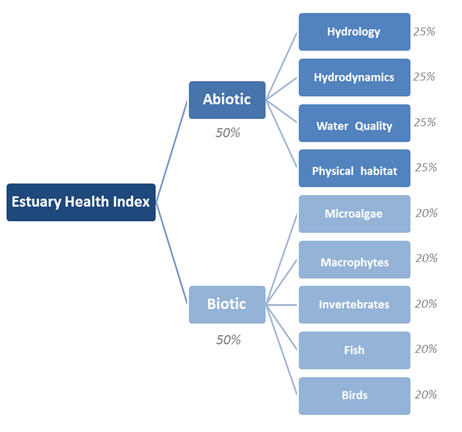
Figure 4. Components and weightings of the Estuarine Health Index2.

The approach requires that a multidisciplinary group of estuarine scientists assesses the health of a particular estuary in a workshop setting and is based on their collective understanding of likely impacts affecting that system. Available information and expert knowledge are used to build a “picture” of the natural state of an estuary and the changes that have occurred under present conditions. For each of the components (abiotic and biotic), the change in condition is estimated as a percentage (0 – 100%) of the natural state. Scores are weighted (25% for each abiotic and 20% for each biotic component) and aggregated (50:50) to provide an overall score that reflects the present health of the system as a percentage of that under natural conditions. The index score in turn corresponds to an Ecological Management Category to describe the health of  the estuaries using six categories, ranging from natural (A) to critically modified (F) (Table 3). These in turn have been cross walked to the NBA condition assessment categories.
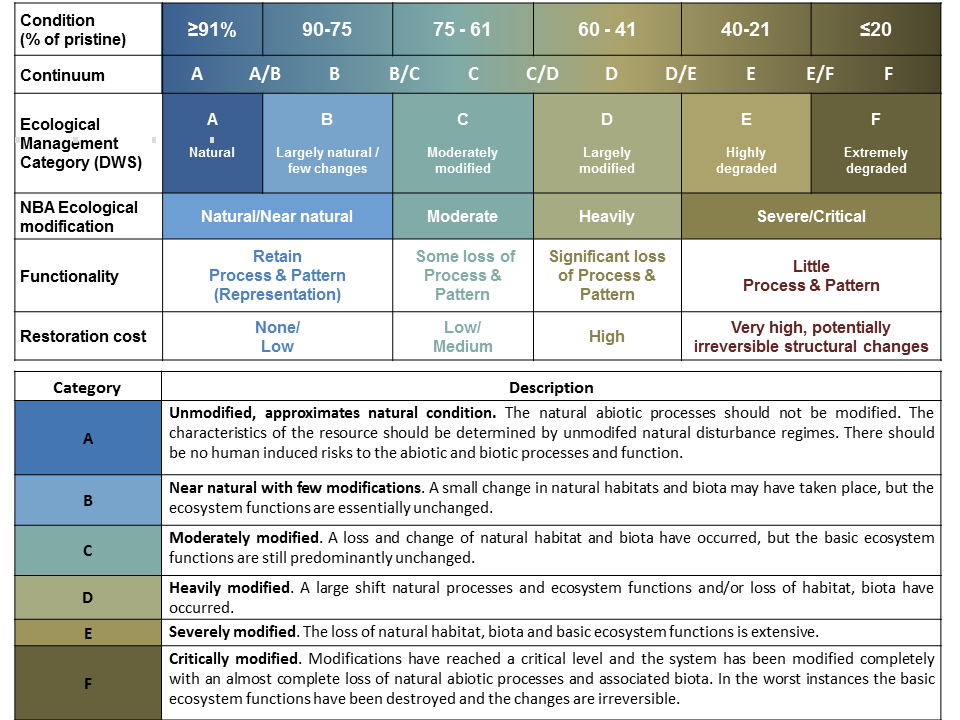
Table 3. The relationship between loss of ecosystem condition and functionality (modified from Van Niekerk et al. 2013).

To develop a clear understanding of the status of estuarine health within South Africa, large complex systems such as the Lake St Lucia Estuary were disaggregated into separate sections, namely Lake St Lucia and the uMfolozi Estuary. Similarly, the uMhlathuze Estuary and Richard’s Bay Harbour were evaluated separately. Consequently, the country-wide health assessment was conducted for a total of 290 estuaries.

Technical documentation

Key Publications

Van Niekerk, L., Adams, J.B., Lamberth, S.J., MacKay, C.F., Taljaard, S., Turpie, J.K., Weerts S.P. & Raimondo, D.C., 2019 (eds). South African National Biodiversity Assessment 2018 Technical Report Volume 3: Estuarine Realm. CSIR report. South African National Biodiversity Institute, Pretoria.

Van Niekerk, L. et al. 2013. Country-wide assessment of estuary health: An approach for integrating pressures and ecosystem response in a data limited environment. Estuarine, Coastal and Shelf Science 130: 239–251. https://doi.org/10.1016/j.ecss.2013.05.006

References

1. Lamberth, S.J. & J.K. Turpie. 2003. The role of estuaries in south african fisheries: Economic importance and management implications. African Journal of Marine Science 25: 131–157. https://doi.org/10.2989/18142320309504005
2. Water Affairs, D. of & Forestry. 2008. Water resource protection and assessment policy implementation process. Resource directed measures for protection of water resource: Methodology for the determination of the ecological water requirements for estuaries. Pretoria, South Africa.
3. Turpie, J. 2013. The estuary health index: A standardised metric for use in estuary management and the determination of ecological water requirements: Report to the water research commission. Water Research Commission.
4. Adams, J.B.B. et al. 2002. A method to assess the freshwater inflow requirements of estuaries and application to the mtata estuary , south africa. Estuaries 25: 1382–1393. https://doi.org/10.1007/bf02692232
5. Van Niekerk, L. et al. 2013. Country-wide assessment of estuary health: An approach for integrating pressures and ecosystem response in a data limited environment. Estuarine, Coastal and Shelf Science 130: 239–251. https://doi.org/10.1016/j.ecss.2013.05.006
6. Van Niekerk, L. et al. 2019. Assessing and planning future estuarine resource use: A scenario-based regional-scale freshwater allocation approach. Science of The Total Environment 657: 1000–1013. https://doi.org/10.1016/j.scitotenv.2018.12.033